
Exploration, excitement, experience
PADI Advanced Open Water Diver
That is what Advanced Open Water is about: rated the easiest course in the PADI series, and the one that widens your horizons most.
At a glance
Five adventure dives, each with its own theory, and no tests or exams. Deep and navigation are required; you choose the other three.
- Minimum age
- 12 years
- Prerequisite
- PADI (Junior) Open Water Diver
- Dives
- 5 adventure dives
- Depth
- Deep dive, between 18 and 30 m
- Exams
- No tests or exams
- Where
- Eforie Sud, one weekend
Who it is for
For new Open Water Diver graduates and for divers who are already comfortable in the water, with some experience, who want to try something different and learn new skills. The course builds confidence and extends your abilities through adventure dives.
PADI (Junior) Open Water Divers aged 12 or over can enrol. Younger divers can join only certain adventure dives; ask your instructor.
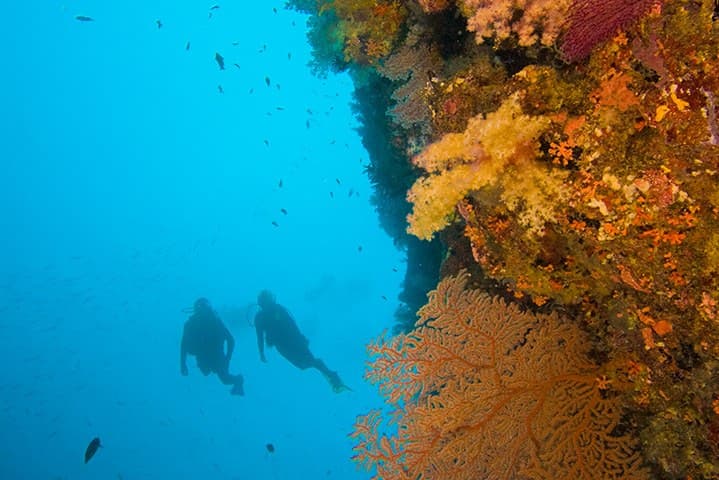
Adventure dives are not specialties
They are introductions. Each one can count as the first dive of a specialty. All are logged as Adventure Dives and later credited as the first dive of the matching specialty. For details, see the page of the specialty you are interested in.
The two required dives
- Deep
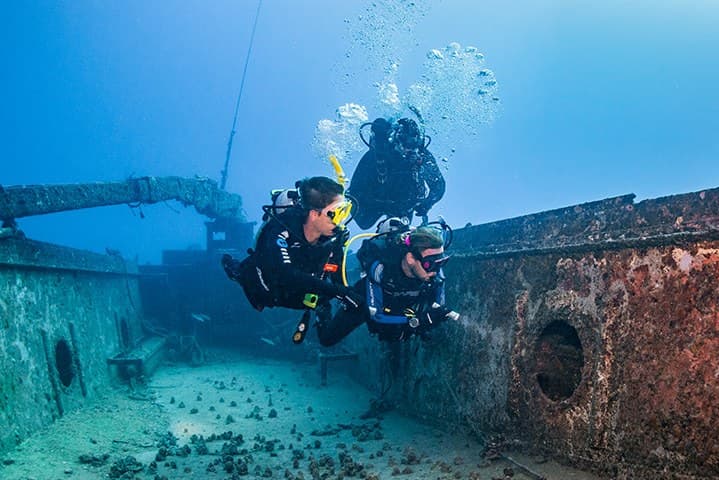
- Between 18 and 30 m. You learn to plan dives that deal with the challenges and physiological effects of depth. You go further into dive physics and how to stay within safe limits without exceeding recreational time limits. You practise the safety stop, learn why it is now close to mandatory, and what precautions to take. You learn why every detail of the plan matters, why you agree it with your buddy beforehand, and why you stick to it. It opens the way to other adventure dives, such as wreck diving.
- Navigation
- You refine your use of the compass underwater and learn to navigate with kick cycles, natural references and time. The focus is on navigating while still enjoying the dive. The reason is simple: you need to find your way back to the boat, or follow directions so you do not miss the goal of the dive.
A typical schedule
One weekend at Eforie Sud: theory on Friday evening, themed dives on Saturday and Sunday.
| Day | Where | Hours |
|---|---|---|
| Friday | Eforie Sud, theory | 18:00-21:30 |
| Saturday | Eforie Sud, themed dives | 11:00-18:00 |
| Sunday | Eforie Sud, themed dives | 10:00-17:00 |
Groups are usually no larger than 6. Get in touch early. One-to-one (VIP) training is also available.
Three dives of your choice
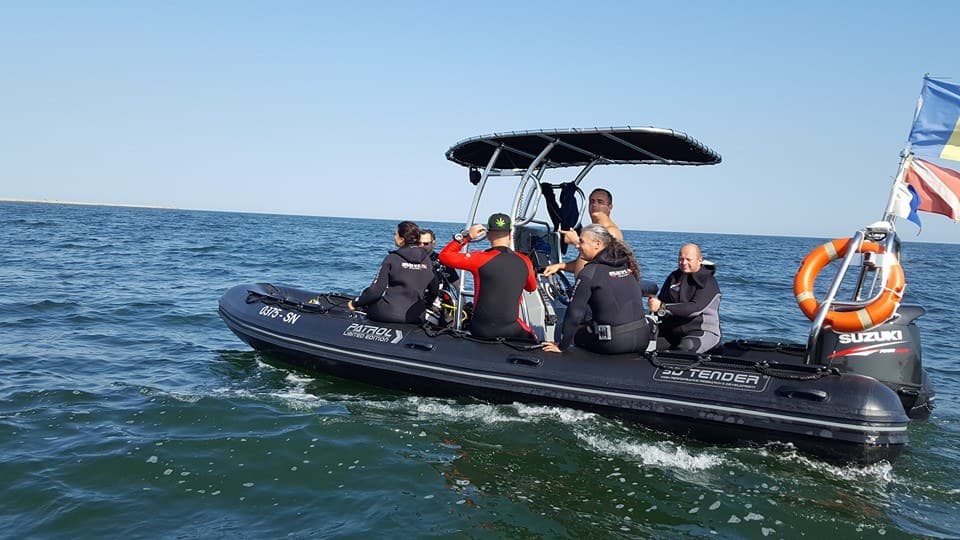
- Boat
- The parts of a boat, the kinds of dive boats, the diving done from them, entry techniques and how to approach the dive.
- Underwater photography
- How to use a camera underwater, how it differs from conventional photography, and the adjustments needed for sharp images with accurate colour.
- Diver propulsion vehicle
- How to use an underwater scooter to move around more easily.
- Drift
- Medium to strong currents that you cannot swim against and must go with. Types of current and what to do if one catches you by mistake.
- Multilevel and computer
- How to plan dives across several depth levels and keep to the plan throughout.
- Night
- The other face of underwater life: predators that come out to feed at night, and fish that sleep and let you come closer. A favourite of photographers and videographers.
- Peak Performance Buoyancy
- Tricks you also get to practise, for better balance in the water and better buoyancy.
- Search and recovery
- Navigation and search patterns for small and large objects lost on the seabed, and recovering them with lift bags and buoys.
- Underwater videography
- The same challenges as photography: you learn how to compensate for good footage.
- Wreck
- You visit a wreck, usually deeper than 18 m, and learn to recognise the risks of penetrating it, which is covered further in the specialty.
- Altitude
- What to account for when diving in a lake at altitude. It needs extra logistics and usually extra cost.
And more.
Equipment
As well as basic scuba equipment, you need a compass and a knife, plus specialised kit for the dives you choose. Your instructor explains everything and may suggest extras, such as a torch for the night dive or a lift bag for search and recovery.
At this level you need your own accessories: a surface marker buoy with reel, a torch, a knife and a compass. The rest of the equipment is provided by our centre.
Video
PADI Advanced Open Water Diver Course
Frequently asked questions
Are there exams?
No. Each dive has a theory part, but there are no tests or exams.
Which dives are required?
Deep and navigation. You choose the other three based on what interests you.
Ready to go down?
Call or write to us and we will find the right course and schedule together.